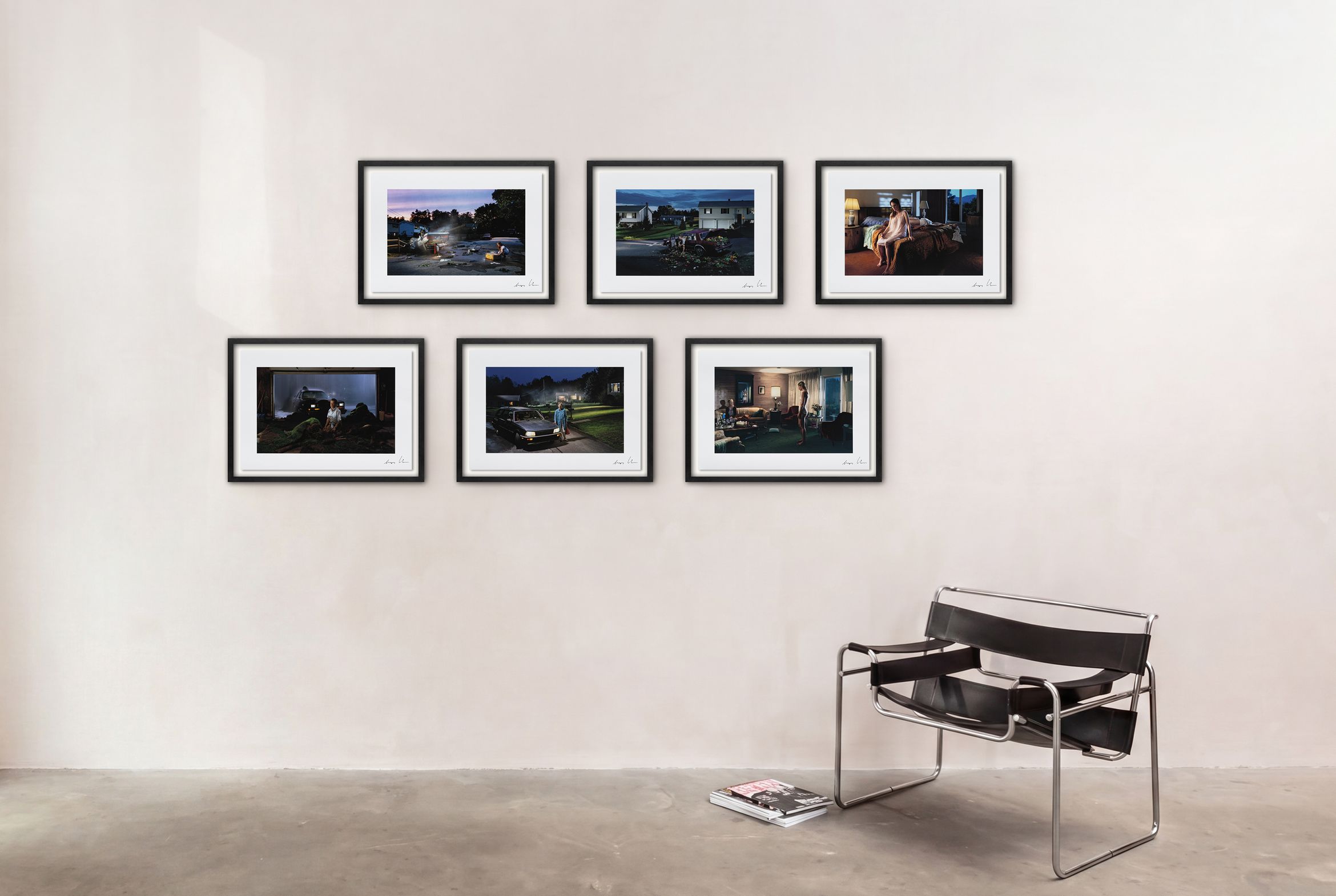
Created for The New York Times Magazine at a secluded location in Vermont, ‘Dream House’ remains a unique chapter in Crewdson's career: a self-contained body of work suspended somewhere between everyday life and cinematic fiction.
Ahead of our 48 hour release of six of the iconic pictures from the series, we spoke with Crewdson about living inside the Dream House during production, directing Hollywood royalty, and why the real star of his work will always be light itself.
Many years have passed since the ‘Dream House’ pictures were created. What role would you say time plays in your art?
I hope to create a kind of timelessness in my pictures. I want them to feel like they could exist in any moment, outside of time in a sense. And I work really hard to do that in terms of the iconography of the pictures. I never really include any indicators of contemporary life. But at the same time they're not meant to be a period piece.
They should just feel familiar and ordinary, in terms of the world that we're building. And then I'll try to transform that into something that feels mysterious and beautiful through light and color and mood.
'I felt like I was lost in my own pictures. It was haunting in a certain way, but also really beautiful.'
Gregory CrewdsonProduction image taken on the set of Dream House, 2002, Rutland, VT. Courtesy Crewdson Studio.
Gregory Crewdson with Kathy Ryan on the set of Dream House, Rutland, VT, 2022. Courtesy Crewdson Studio.
How would you best differentiate ‘Dream House’ from your other works? Can you tell us how the project came about?
It really is a standalone project. I had just finished 'Twilight', which was a kind of emblematic body work for me because it was the first time I started working with cinematic lighting. That series lasted a few years. I was still trying to figure out what the next body of work would be.
Then Kathy Ryan, the photo editor of the New York Times contacted me and asked if there was any portfolio work or a body of pictures that I'd be interested in doing for the New York Times Magazine. So I met with Kathy, we had lunch and I had really no expectations… except there was a house that I had found while in production in Vermont.
It was owned by a family, but the matriarch of the family had passed away a few years ago. And they left it as is, a kind of tomb in a way. It had a really strange beauty to it. Almost like a diorama from another time. So I mentioned this to Kathy, and then we talked about using that as a location and perhaps working with known actors, which is something I hadn't done or tend not to do generally.
We came up with a list of names that I felt connected to, who felt like they could inhabit the world of my pictures. It was a very short list. Tilda Swinton, Philip Seymour Hoffman, Gwyneth Paltrow, Julianne Moore, a few others. And that started the process. We made the pictures over the course of the summer.
I basically stayed up there, lived in the house, and actors would come on their own every few days. We shot what turned out to be twelve pictures altogether. It was, for me, a beautiful collision of everyday life and something that felt heightened and cinematic.
Production image taken on the set of Dream House, 2002, Rutland, VT. Courtesy Crewdson Studio
What was it like actually living there, in the Dream House?
I felt like I was lost in my own pictures. It was haunting in a certain way, but also really beautiful. I was in a kind of dream state. And I think spending time there alone in between pictures really helped a lot. I would wander around the house and plan the next picture.
It all had a kind of beautiful simplicity. Each actor would come up on their own without publicists or makeup or hair.
The challenge really was to work with these very known actors and have them come into my world, as opposed to me going into their world. And I feel like that was part of the interesting tension in the pictures.
'There's that mysterious exchange between the subject and the camera, which either happens or it doesn't. And that's all part of why you make the pictures.'
Gregory CrewdsonDid you already know which stories you wanted to tell before each actor arrived?
That's the way I work. I always have the picture mapped out before they arrive, and a general sense of the frame and what they would be wearing, the mood of the picture. In the Gwyneth Paltrow picture, which is one of my favourites in that group, I knew I wanted that interesting dynamic between the older mother-like figure sitting on the couch and the reflection of Gwyneth in the mirror. I knew I wanted to capture a mood of quiet alienation and psychological tension.
Did all of the actors' performances pan out exactly as you expected, or did you have to adapt?
It's never exactly how I imagined. There's always things that are unexpected, so you do everything you can to try to create the perfect frame and all the details of what's in the picture. But then there's that mysterious exchange between the subject and the camera, which either happens or it doesn't. And that's all part of why you make the pictures.
It’s a collision between my own expectations and something that pushes up against that in some way. Some sense of mystery or something that surprises you in one way or or another.
But I knew they would all be great because they're all actors that I deeply respected and so it was a really exciting kind of exchange. Each and every one of them were up for it one hundred percent. As I said, they arrived alone, outside of the realm of a studio shoot or film set, so there's just a different kind of energy.
And it was really exciting to work with Kathy, who's such an iconic figure and who was there for a lot of it. I think we both loved the experience and found it very meaningful. It was the first and only time I ever did anything like this. I haven't done anything similar since then, and I don't think I would because we did it in those pictures.
Details of Untitled [Dream House 1]
Details of Untitled [Dream House 3]
Details of Untitled [Dream House 4]
'It was the first and only time I ever did anything like this.'
Gregory CrewdsonHow do you think using famous faces affects the work, in comparison to featuring unknown models?
It's something I tend not to do. I tend to work mostly with people who are not actors at all. People who we find one way or another through open casting or just meeting people in local neighbourhoods. So that was a great challenge to me.
One of my only instructions in terms of my director's note is I always wanted them to do less. It's not like a film or other narrative forms, you're really trying to capture a kind of inbetween state. I have a distinct memory of just saying “less”, you know, “give me less”. I wanted almost nothing.
All the pictures I make are about moments in between moments. Even though they're narrative, and there's suggestions of a story being told, they're always kind of open-ended. There's a sense that something just happened, or something's about to happen. But in the moment of the picture, everything feels emptied out.
Did you give the actors any backstory to work from, or was it more about conveying a particular emotion?
I tend not to give any notes about motivation or plot or story. I really don't know what's happening in any particular picture. I want the ultimate meaning to be a mystery, even to myself.
I make very subtle moves in terms of positioning the body, bringing out a certain kind of quiet gesture. Often I'm looking for a moment that feels psychologically complex, like an underlying sense of guilt or shame or regret or expectation. But all these things should feel submerged.
A still photograph is one frozen moment in time. So there is no beginning and no end. What I want to do is invest that one moment with as much beauty and mystery as possible. And you do that primarily through light. So light is the key narrative code that I use. It's about trying to create a world through light.
'I want the ultimate meaning to be a mystery, even to myself.'
Gregory CrewdsonYou also make great use of objects to help tell your stories. Can you tell us how this worked for ‘Dream House’?
Everything in the ‘Dream House’ pictures, all the props, all the paintings and blankets and glasses, everything was from the actual home. We didn't bring in any props whatsoever, and that was part of the parameter of the project that we'd use only what was already in the house.
And it’s all of those things that make a picture work or not. Like a glass of water, putting a different painting on the wall, the wallpaper, the windows and the shades and the curtains. All of these things add up to tell the story. It's not just one thing.
It's also the relationship between the figure and the setting. That’s so important to me. It's not just the actor, it's how the actor exists in the space and how they're framed by their domestic surroundings. The mirrors and windows and doorways are all key in creating the frames within frames.
Your work in particular very much involves the viewer. What role do you think that the audience plays in completing an image?
I feel like my job as an artist is to try to make the most beautiful and mysterious picture as I can using various production lighting and props. But the pictures aren't complete until the viewer responds to the pictures and makes their own version of what happened.
I really want them to bring their own stories, their own history, their own fears and desires, and to create their own meaning in terms of what the picture suggests and what's happening.
GREGORY CREWDSON, 8x10 Polaroid Study, Dream House, 2002, ©Gregory Crewdson
'It's about trying to create a world through light.'
Gregory CrewdsonHow do you feel about the crossover between art and AI? Do you think your hands-on shooting style has even more value in the current climate?
I don't have any strong opinions on AI. Like Photoshop or even analog photography, everything's a tool to be used. What's more important is the artist's vision, that intersection of subject and form that creates a body of work or a way of seeing the world.
I do feel that my particular pictures are, despite their larger production and use of light, really dependent on a certain kind of reality, like a place. And also on the process. The process of making the pictures is so important to me.
I guess, you know, you can make a version of those pictures with AI. But it's not the same. It’s not the same as location scouting and spending months looking for places that feel like they could accommodate your story, and then creating these lighting setups and capturing the perfect moment. And then seeing the picture unfold in front of your eyes.
For me, that’s the reason to make pictures. It's to see it come to life, and to see a place that's been transformed. I don't think that will ever change for me. There are certainly easier ways to make pictures than the way I do, but it's the only way I know how to make a picture.
When you look at these photos now, do you get a different sense of them than you did when you first made ‘Dream House’ 25 years ago?
You know, things change and life moves on. I still love each and every one of the pictures. But you look at it with a certain amount of distance and time, and you can't help but think about your own life and how things have changed. And so in a certain way for me those pictures are like a time capsule.
Or maybe a timeless capsule.
I now also see how deeply connected they are to all my other pictures. Despite the fact that we’re using well known actors in this very particular way, there's a continuity to everything. It's like it's all coming out of a central story. I can now see those pictures as being more rooted in the evolution of all my pictures.
We even made pictures more recently that in one way or another feel like a veiled reference to these pictures. It’s like, you can't get away from yourself. It's who you are and it's all part of the story that you're trying to create.

‘Dream House’ is our second collaboration with Gregory Crewdson. Six limited edition signed prints will be available to collect on 30 June at 17:00 UK time for 48 hours only. Sign up to register for updates and set a reminder for the launch.


