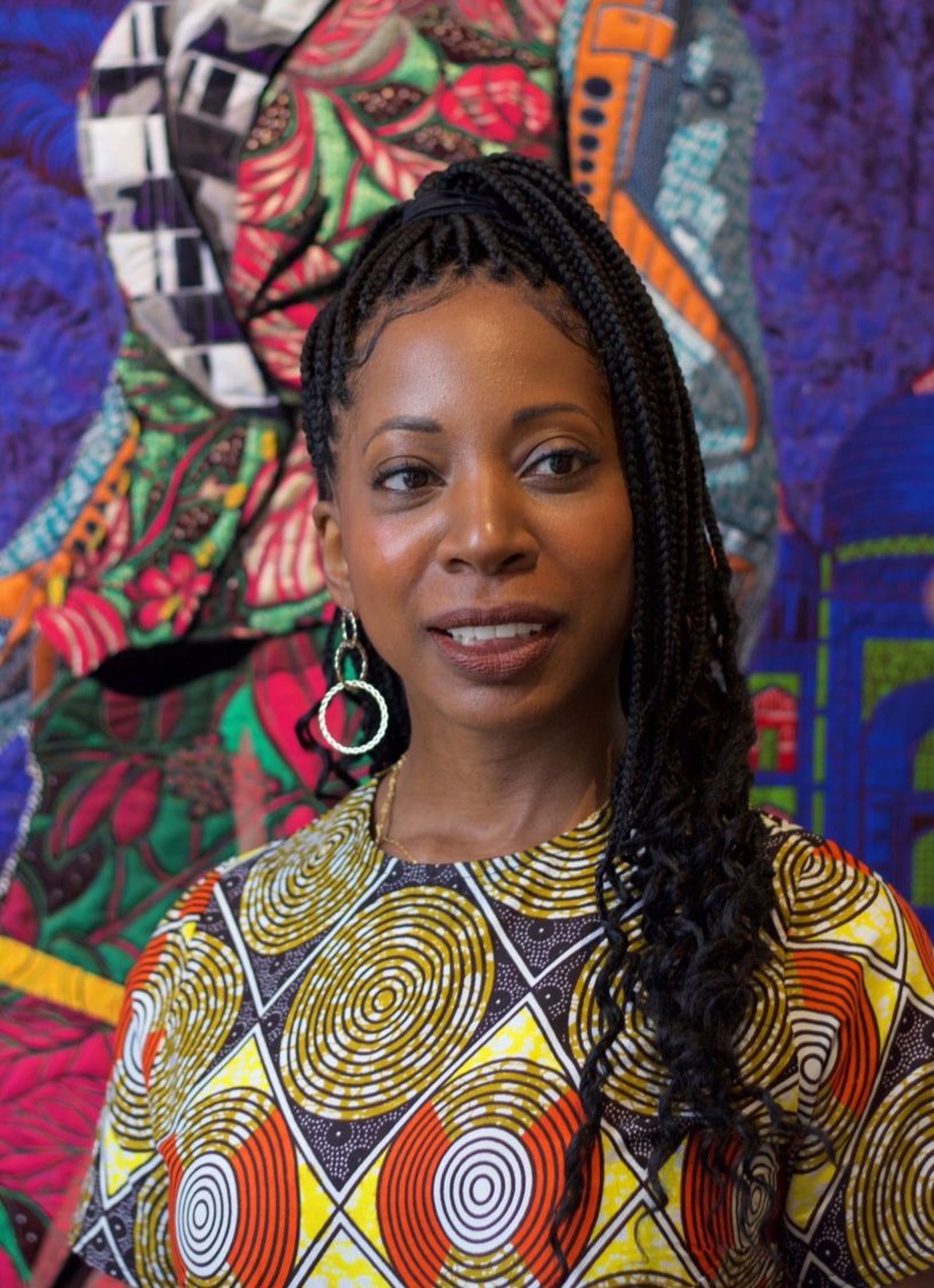
Bisa Butler is a renowned textile artist, known for breathtaking quilted portraits that centre the Black lived experience. During the preparations for our 48 hour release of two of her most beloved works, we spoke to the artist about her exquisitely vibrant practice.
In conversation with Bisa Butler
How did you start out as an artist?
I've always loved art since I was a tiny girl. My mother gave me the freedom to draw on the walls, which was kind of crazy when you think about it.
I was afraid to sleep alone, and I drew these huge, big-headed creatures with big eyes and little stick arms sticking straight out of their heads. My mother was fussing at me, asking me why I drew on the wall. And I told her, those were my guardian angels. So I guess you could say that was my first mural, and my mother accepted it and let them stay, because it also gave her peace of mind that I would stay in my own bed at night.
So from then on, I always knew that I was an artist. People in my family called me that. People at school knew I was an artist. I was good at every type of art, sculpting, painting, drawing, or at least the traditional ones that are presented to children in school. And by the time I graduated high school, I was certain I wanted to major in art at college.
Where did you study?
I had enrolled at Howard University. I actually went into Howard for architecture, but that wasn't of my own free will. That was more my father's influence, thinking architecture was a way where you could make money and be creative, and then you'd have a solid and stable career. But unfortunately, architecture was not for me at all. It had way too many rules and not enough color.
So by sophomore year, I switched to the painting program because I thought well, to be an artist, I suppose that means that you’re a painter. But I found myself struggling, like so many young artists do.
I could paint anything. I could paint like anyone. I could paint like Picasso or Matisse or draw like Charles White. But I would just copy what they did. I didn't have a style of my own. We did a lot of painting from life. There'd be a model in the center of the room and we'd all be painting. But I noticed some of my classmates had started to develop a unique style. Their brushstrokes had a unique composition. The colors they chose reflected their own personality.
Mine didn't look like that at all. I always felt like mine looked almost photo perfect, or as photo perfect as I could get it. I just recorded things exactly as I saw them, with no real personal input for me. And I struggled with this because that's not the type of artist that I wanted to be. I wanted to be creative and unique and dynamic.
That is the moment that I understood. While my technique may not have been perfected, I was on to something new, and I was able to express myself in a way that I wasn't able to do with a paint and a paintbrush.
How did you cope with the frustration of not being able to express yourself fully through painting?
I expressed all this to my professor, Al Smith – who was the head of the painting department at the time – And Al said, okay, I see what you're talking about, but I need to see where you paint. I need to see what your environment is like.
So he met me at my house one day. I lived in a house off campus with like five other friends, and I was the only artist in the house. This was the mid 90s. Hip hop music was very popular, we always had Biggie Smalls playing or Tupac or A Tribe Called Quest or De La Soul.
So Al Smith came over, the music was playing, my friends were cooking in the kitchen. There was a lot of activity. People stopping over, hanging out in the living room. Our dining room was basically empty, we had a table with no chairs, so that was my studio. So it was right in the center of the house, amongst it all.
And I always dressed with a lot of personality. I loved African clothing, I loved upcycling. But modern African clothing was just not available to a person who was not traveling back and forth to Africa. You could get some modern African clothing in Harlem at certain markets. But here I was in Washington, D.C., and so I had to customise things myself and add in African fabric.
I would spend all this time sewing and changing and going thrifting after classes, going all over DC to fabric shops and altering my clothing – and not understanding that that's where my true passion was. I would replace the sleeves of my jean jacket with lace. I would hand paint designs on my jeans. My whole wardrobe was a work of art that was missing from my actual paintings.
Al Smith, when he came over, he saw all of this. He said look at how you dress. Look at all this culture around you. Look. Listen to these sounds. Look at all your friends. None of that is in your artwork.
I want to see you put yourself in your artwork. Why aren't you using fabric?
And I had never considered it before. He told me to go look at the work of Vermeer. I also spent three hours at a free exhibition of Romare Bearden’s work, just looking at his artwork, absorbing it, thinking about it, and synthesizing it.
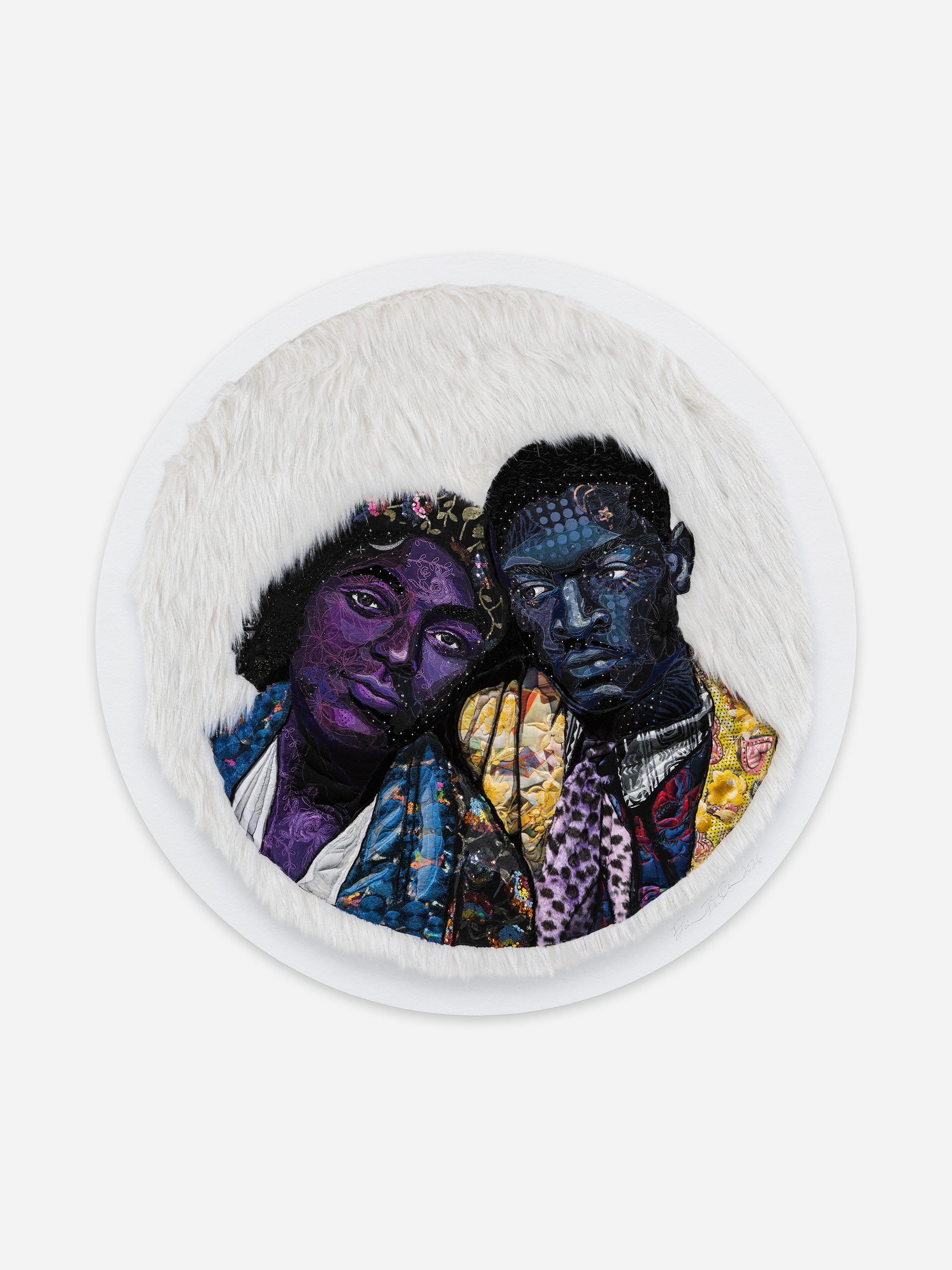
My Cherie Amour, 2025
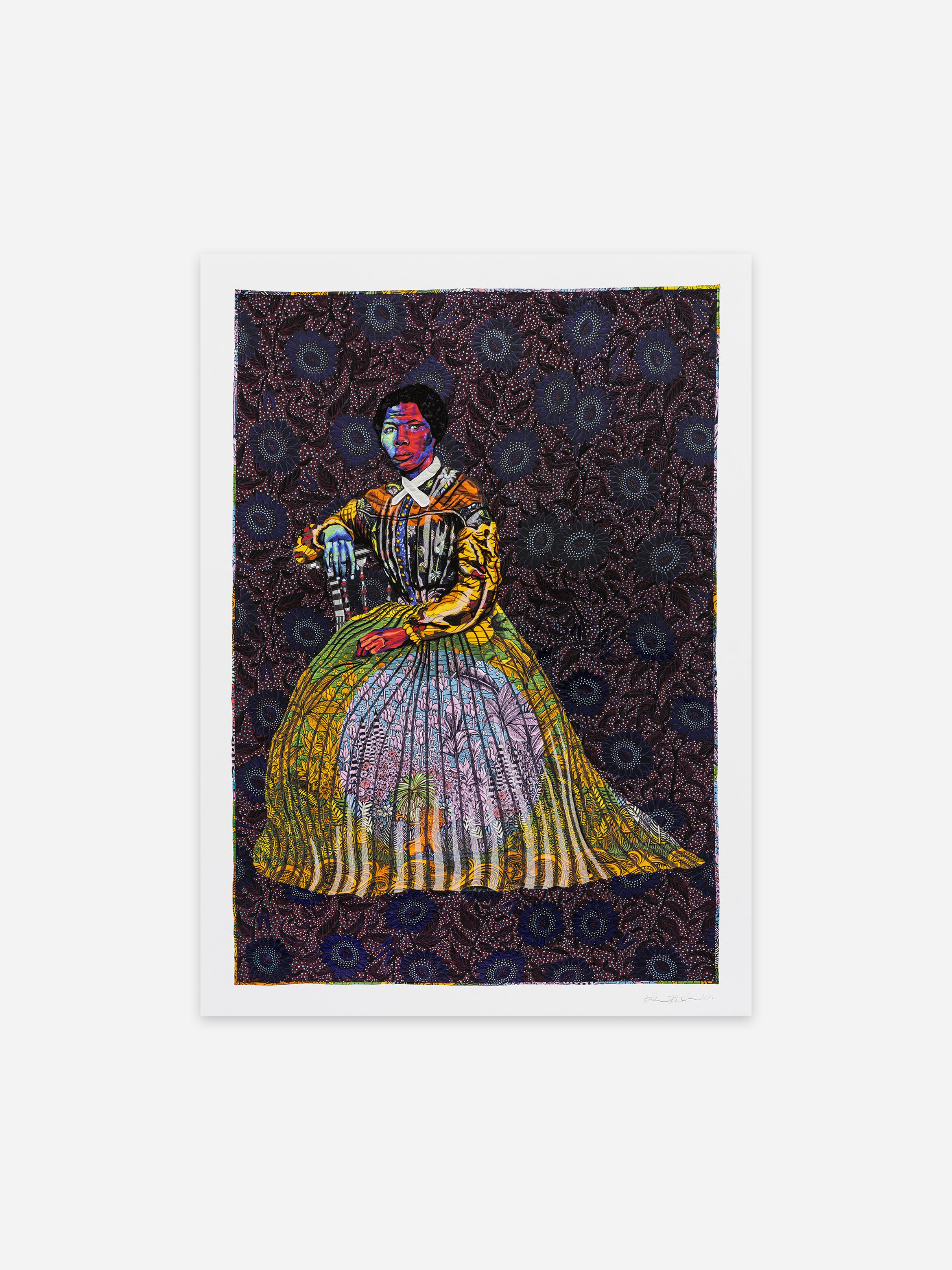
Coco With Morning Glories, 2024
What did you do with these new-found influences?
As soon as I got home from the Bearden exhibition, I made my very first fabric portrait. It was pretty rough, I will say. And I still have it. It looks more like a mask than a realistic portrait. I used velvet and lace and satin, and it's telling that those are still fabrics that I use to this day.
Next time I had class, it was critique time, so everybody had to show what they had been working on. And I was so embarrassed to pull out this mask-like fabric face, but I had to. That was the work I had been doing.
And so I pulled it out and Al was thrilled. He was so happy. I remember that moment, he was like, that's it! That's it. That's what I'm talking about. This is it.
It was a real breakthrough. That is the moment that I understood. While my technique may not have been perfected, I was on to something new, and I was able to express myself in a way that I wasn't able to do with a paint and a paintbrush.
How would you describe your current practice, all these years later?
This has been one of the most interesting times in my life. The highs and the lows. As my mother always said, there'd be times like this! I am so thrilled and so happy because my show is finally going to open at the Smithsonian American Art Museum on March 18th, 2027, and that has filled me with profound joy.
But in this time, I have also been experiencing some of my lowest lows. I have closed my outside studio and I'm working from home, all because I discovered a few months ago that I have an aneurysm. And what that has done is forced me to slow down. It has forced me to think about every single day and take my time. Everything doesn't have to be a rush.
At first I was really struggling. It was hard for me to get things done and I had to think to myself, what are you made of? What is it that you've been put here for? And what is it that you still have yet to do? And I realized that there were things that I could do. I could make prints. I could lay down these tiny, tiny jewels, tiny rhinestones, and take my time, one at a time.
As I laid each jewel down and picked up a tiny pair of tweezers, it became my way of getting back to who I really am. Regaining my stability. Reconnecting blood vessels in my brain that may have not been connecting the right way. These shimmering jewels, all these little bits, each one laid by hand is me. Clawing my way or climbing my way back to who I used to be.
I look at this period of time with profound, profound joy and respect. Respect for life. Respect for the Almighty and profound thankfulness that I have a team surrounding me who cares about me. And that includes my assistants, Yasmeen and Ivor, and my family, my Smithsonian team, Liz and Delila and Maria. Every little bit counts.
And all of you who have a kind word or a thought, you matter as well. I hope to see you all in March. I hope that we can celebrate together. Take care.