Uncover the layers of symbolism in the fabric of I Go To Prepare A Place For You
The Fabric of Meaning
Bisa Butler is a celebrated textile artist, known for intricate and intimate portraits that honour the lived experience of Black people across history.
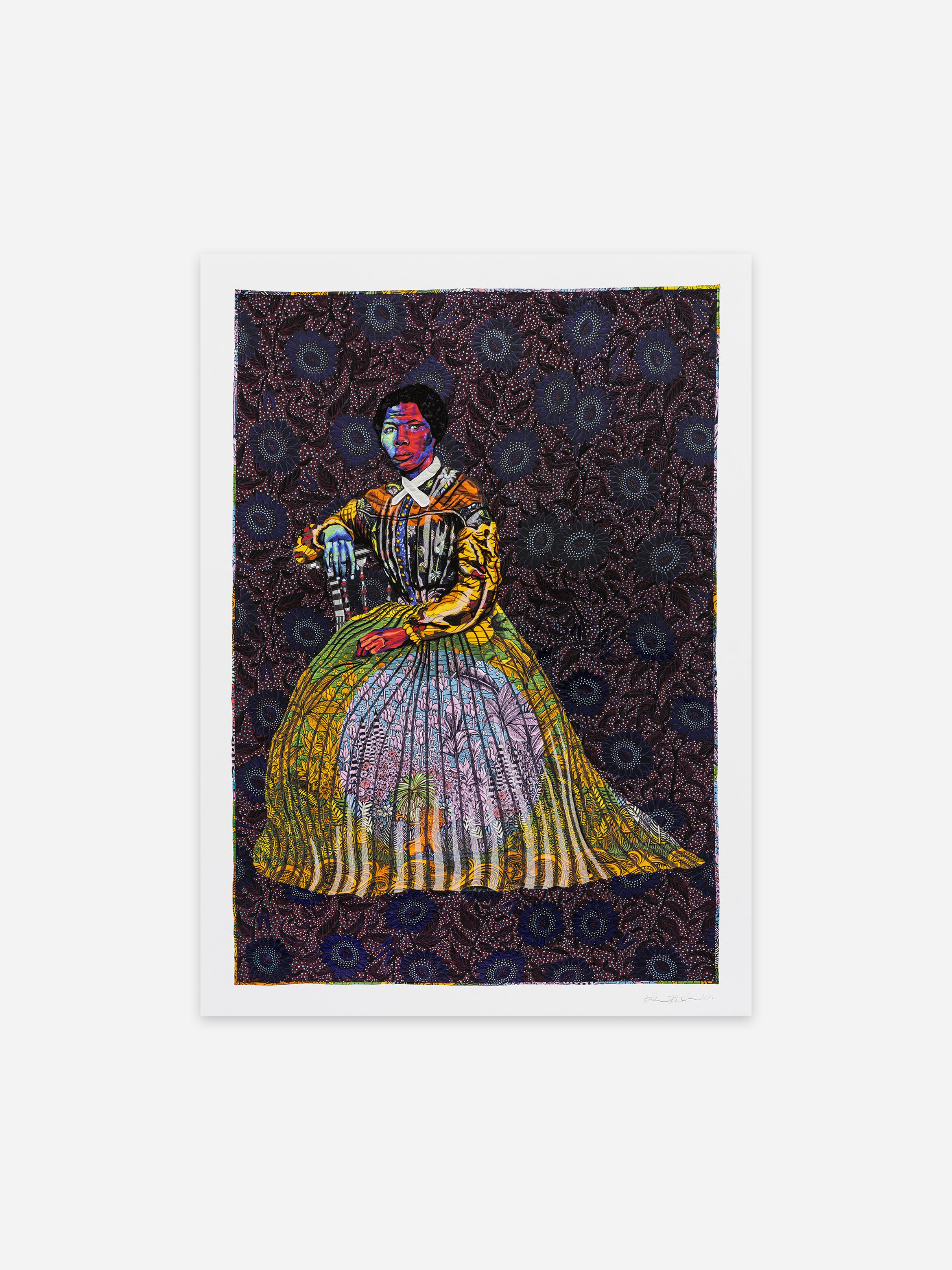
As part of our debut collaboration with the artist, we’re honoured to bring her breathtaking portrait of abolitionist and social activist Harriet Tubman to print for the very first time.
Here we’ll explore some of the key motifs of I Go To Prepare A Place For You, a piece in which every inch of fabric is richly woven with symbolism.
Where the fabric comes from
To me, the most meaningful symbol in ‘I Go To Prepare A Place For You’ is not one particular symbol, but where most of the fabric that comprises that piece was made. That fabric was made by a Dutch company called Visco, which has a partnership with the City of Joy in the Congo, a refuge for women who have suffered through war crimes. Sadly, it's women and children who often face the brunt and the most heinous crimes in wartime. While they're not actively involved in any of the fighting, many of these women are attacked, kidnapped, they suffer sexual assaults. Many of them have children because of these assaults. And they are left without a village, without a home and without a way. But the City of Joy is a place of refuge where they can go and get health care and shelter, their children can receive education. They can find a place to belong. On Harriet Tubman’s skirt, you'll see these long rows and something that looks like waves at the bottom, with a jungle and a thicket. The women said that represented them when they were in their toughest times in their life. As you move from her hem up towards her waist, the thicket gets lighter and lighter. You start seeing flowers, you start seeing clouds, and at the top, at her waistline, you'll see not only clouds, but sunshine and birds and even hearts in the clouds. Because that is how the women felt when they arrived in the City of Joy. And I thought that was a perfect metaphor for the trouble and the strife that Harriet Tubman went through to escape from slavery and escape from her torturers.
Bisa Butler
Butler’s original work is held in the collection of the National Museum of African American History and Culture, Washington DC. This edition brings the artwork into print for the first time, with proceeds supporting Smithsonian American Art Museum and Renwick Gallery and National Museum of African American History and Culture.